AI and the Performance of Workers with Disabilities
Workers with disabilities face persistent disadvantages in labor markets, including lower employment rates, wage gaps, and discrimination. Technologies that directly raise worker productivity have the potential to improve inclusion while aligning with employers’ financial incentives. In China, food delivery platforms have become a significant source of employment for disabled workers, making them a useful setting for examining this issue.
In Empowering Inclusive Work (NBER Working Paper 35372), Yanyou Chen, Mitchell Hoffman, Huilan Xu, and Zhe Yuan examine the workplace performance of deaf or hard of hearing (DHH) workers on one of China’s largest food delivery platforms. They evaluate the impact of an AI-based communication tool called the Intelligent Outbound Calling (IOC) system that converts text prompts into natural-sounding automated phone calls, allowing DHH workers to communicate with customers without speaking. It was rolled out to all DHH workers in mid-2022, but was not made available to non-disabled workers.
The researchers analyze proprietary administrative panel data covering all 4,284 newly registered DHH workers and nearly 40,000 randomly sampled non-disabled workers who joined the platform between 2021 and 2023. The dataset includes detailed measures of productivity—such as time spent at each stage of order fulfillment—as well as customer ratings, hours worked, attrition, and estimates of wages and platform profits.
The researchers compare the difference in outcomes for DHH and non-disabled workers before and after the tool’s introduction. Before, DHH workers were 4.5 percent slower between leaving the restaurant and delivering the order to the customer, and had 9 percent more late deliveries and 31 percent more bad customer ratings. At the same time, DHH workers worked approximately 5 percent more hours per week and were 41 percent less likely to leave the platform, patterns the researchers attribute to DHH workers having fewer outside employment options. DHH workers completed 5.3 percent more orders per week and generated 12 percent more profit per week for the platform, despite earning approximately 10 percent less per hour than non-DHH workers.
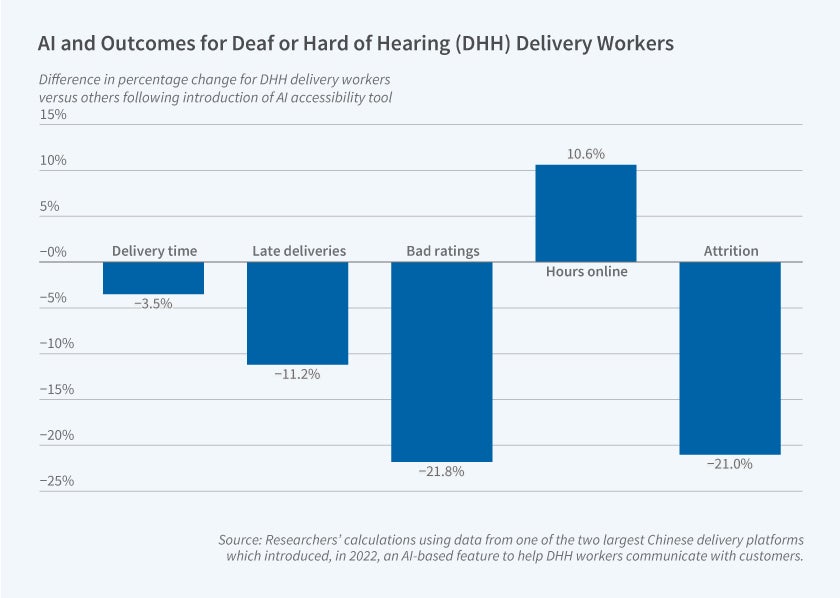
Following the introduction of the IOC tool, delivery times for DHH workers fell by 3.5 percent, closing roughly three-quarters of the prior gap. Late deliveries declined by 11 percent, fully eliminating the pre-AI disparity with non-DHH workers. Bad customer ratings fell by 22 percent, closing about two-thirds of the preexisting gap.
For DHH workers, weekly hours online increased by 10.6 percent and attrition fell by an additional 21 percent. Total weekly orders rose by 11 percent, and weekly platform profits from DHH workers increased by 17 percent. The hourly wage gap between DHH and non-DHH workers narrowed from approximately 10 percent to under 7 percent. The platform’s cost of developing the tool—estimated at no more than $20,000 in engineering labor—was recouped within approximately four days of deployment based on additional profit estimates.
The researchers acknowledge funding from the Ronzetti Initiative for the Study of Labor Markets and the National Science Foundation (CAREER Grant 1941538).