Pass-Through of Tariffs: Evidence from European Wine Imports
The incidence of tariffs on producers, in the form of lower pre-tariff prices, and consumers, in the form of higher tariff-inclusive prices, is a long-standing issue in international economics. While economic theory suggests various possibilities, empirical evidence on the distribution of tariff burdens across the supply chain, from producers through distributors to retailers, is limited.
In Who Pays for Tariffs Along the Supply Chain? Evidence from European Wine Tariffs (NBER Working Paper 34392), Aaron B. Flaaen, Ali Hortaçsu, Felix Tintelnot, Nicolás Urdaneta, and Daniel Xu examine how tariff costs propagate through each stage of the wine distribution chain. The researchers trace price changes from foreign producers to US importers, to distributors, and finally to retail consumers.
The study analyzes US tariffs on European wines that were implemented in October 2019 as part of the Airbus-Boeing subsidy dispute. These tariffs applied a 25 percent rate to still wines with 14 percent or less alcohol content by volume (ABV), packaged in containers of two liters or less, from France, Germany, Spain, and the United Kingdom. The tariffs remained in effect until March 2021.
The researchers employ confidential transaction-level data from a major US wine importer covering October 2018 through March 2022. These data include detailed purchase invoices from foreign suppliers and sales invoices to US distributors. The authors supplement this with Connecticut state price-posting data for distributor-to-retailer transactions and retail price data from e-commerce platform Wine-Searcher. They compare price changes for tariffed wines (still wines at or below 14 percent ABV) with price changes for a control group consisting of sparkling wines and still wines exceeding 14 percent ABV from producers selling only nontariffed products.
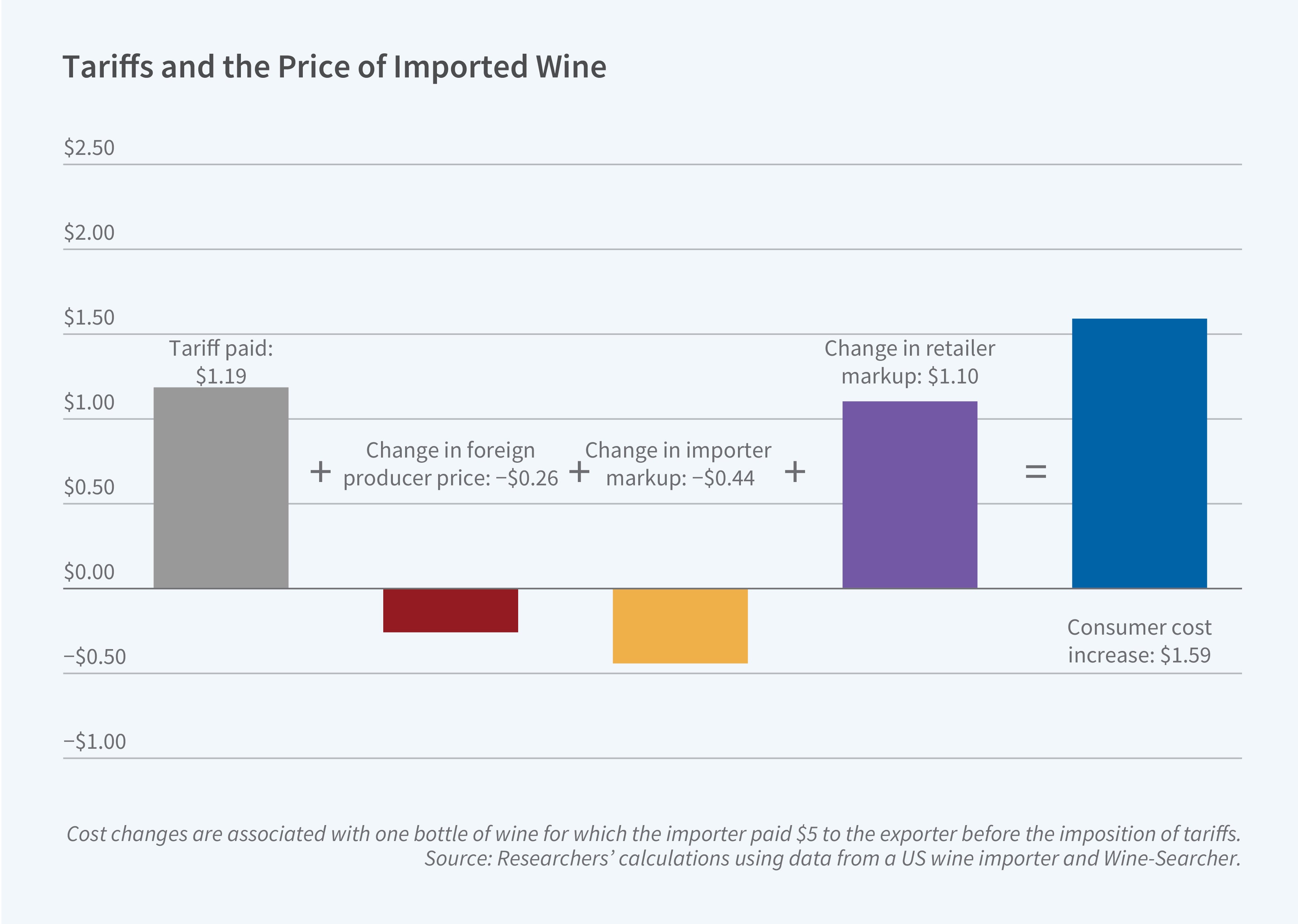
Foreign producers reduced their prices by 5.2 percent relative to the control group following the 25 percent tariff, absorbing about 20 percent of the tariff rate. The remaining 80 percent was passed forward as higher costs to US importers. On a bottle of wine for which the producer charged $5 before the tariff was imposed and $4.74 after, the tariff payment would have been $1.19. Importers, who the researchers estimate apply an 80 percent markup to the price they pay to producers, would have charged $9 to distributors before the tariff was imposed. The researchers estimate that they raised their prices to distributors by 5.4 percent, but on a base of $9 (= 1.8 x $5). This increase would be $0.49, so importers would be absorbing additional costs since they would pay $5.93 (= 1.25 x $4.74) to the producer and in tariffs. All told, the importer’s dollar margins per bottle declined by $0.44.
The distributors who purchased from the importer also applied a markup, which the researchers estimate at approximately 75 percent. Retailers add a further 50 percent markup. The retail price, before tariffs, was about $23 (~ 1.8 x 1.75 x 1.5 x $5). The researchers estimate that the increase in the retail price to consumers was about 6.9 percent. This was on the $23 pre-tariff retail price, so it amounts to $1.59, which, in dollar terms, exceeded the tariff revenue collected.
Price adjustments occurred gradually along the supply chain. Import prices changed within three months of tariff implementation, but retail prices took approximately 12 months to fully reflect the tariff impact. Price increases persisted nearly one year after the tariffs expired.
The study also documents systematic tariff avoidance. The initial tariffs only applied to wines at or below 14 percent ABV and the researchers document a systematic shift in new product offerings toward higher alcohol content products that were exempt from these tariffs, as well as engineering of existing wines to modify the listed alcohol content for exemption from the tariffs. In France, for example, the share of label approvals for products switching from 14 percent or less ABV to more than 14 percent ABV jumped by nearly 10 percentage points in the months directly following the 2019 tariffs. This compositional shift created biases in implied pass-through rates based on aggregate trade statistics, suggesting lower pass-through than actually occurred at the product level.


